
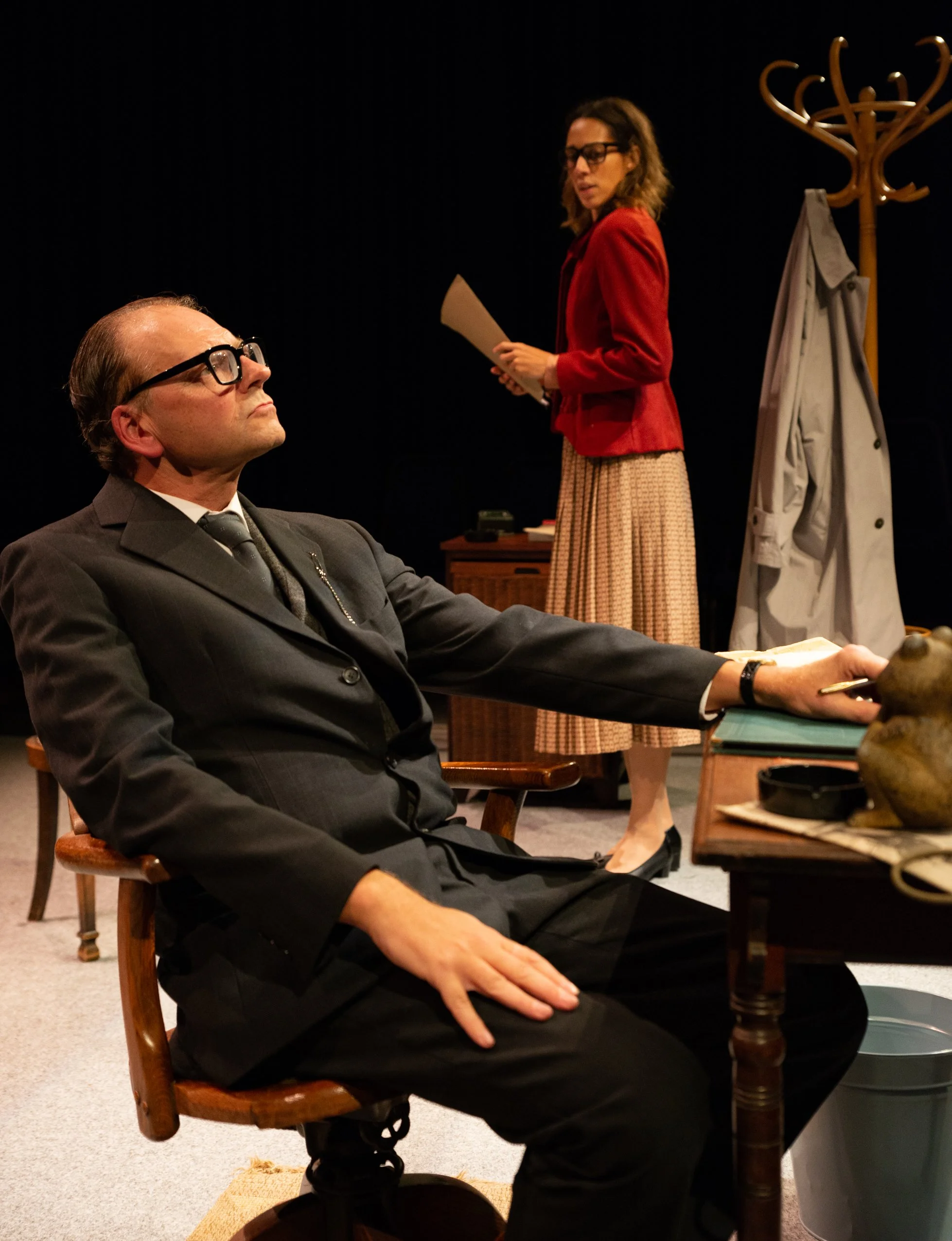
“What will survive of us is love.” - An Arundel Tomb by Philip Larkin
Larkin With Women is an intriguing and illuminating play that explores the surprisingly complicated, interwoven and secretive affairs that Philip Larkin conducted with three key women in his life from the mid-1950’s until his death in 1985.
For all his talk of isolation, Larkin could have married any one of these women, but chose not to do so. Bachelorhood, it seems, was preferable to him, partly to avoid distraction from his art, but also - as many of his poems and letters suggest - Larkin felt that married life was too much of a song and dance.
Larkin’s public persona was that of the no-nonsense, solitary Englishman who disliked fame and had no patience for the trappings of a public literary life. However, it transpires he was also quite a ladies’ man! In Ben Brown’s clever play audiences discover who Monica, Betty and Maeve were, their contrasting personas and how they each gave to Larkin passion, intellect and devotion. Sprinkled with quotes from Larkin’s poems the play provides insights and revelations that are funny, poignant and surprising.
Larkin with Women is a Bath premiere and will be directed in-the-round by Ann Ellison BEM with Brian Hudd taking the iconic role of Philip Larkin in this stylish production.
Cast



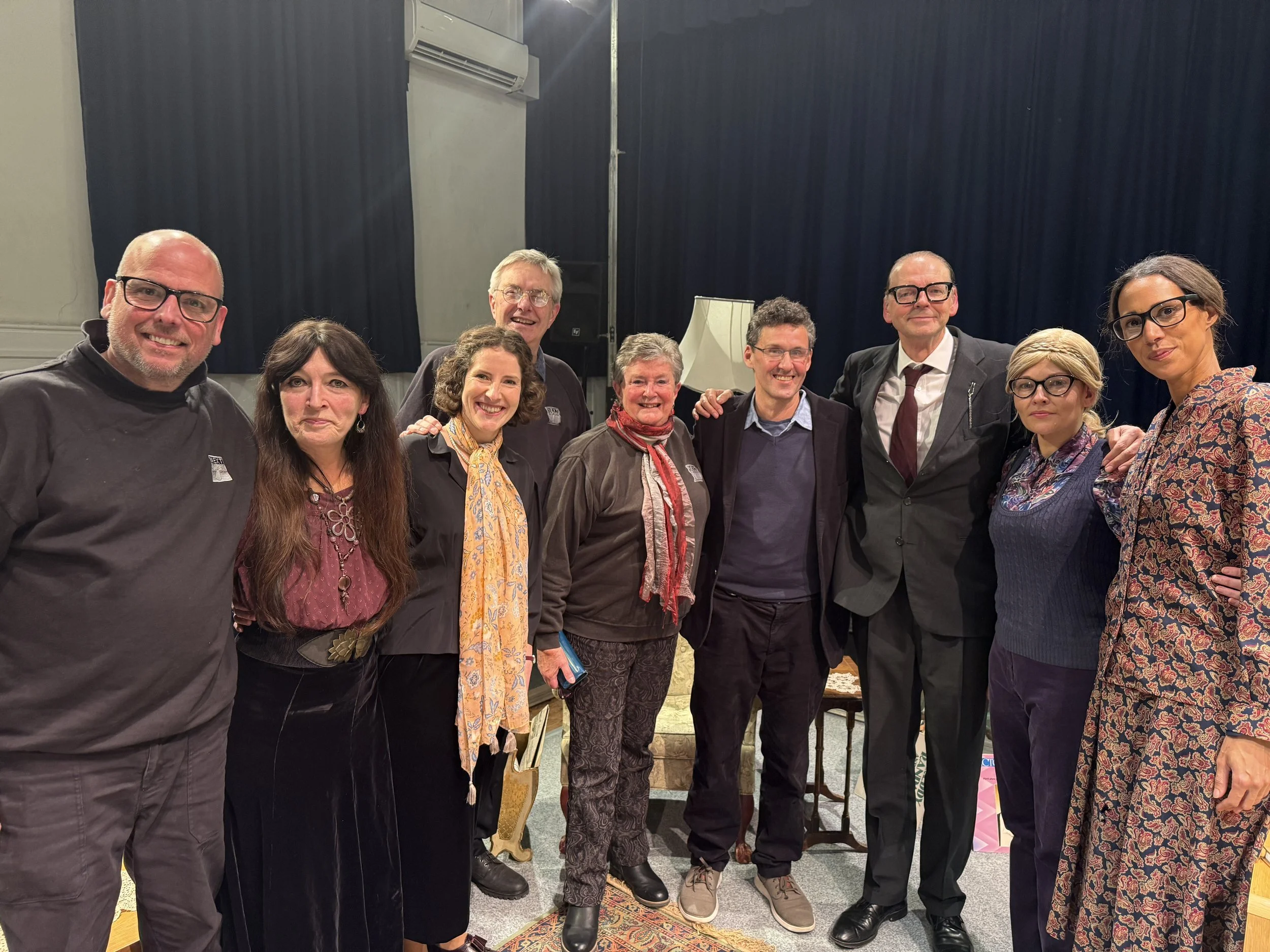
The cast and crew of Larkin With Women with playwright ben Brown on opening night
Reviews:
Where can we live, but days?
What could be better on a chilly autumn evening than a warm Mission Theatre welcome to watch Next Stage Theatre's production of Larkin with Women by Ben Brown? Larkin; a complicated (or to use a modern phrase, problematic) poet who stubbornly refuses to go out of public favour, despite the efforts of some with “modern sensibilities;” a poet of a very specific time and place recording his thoughts and observations in post-war Britain. Perhaps it was his ordinariness, his modesty, his glumness (all very British traits) in combination with his talent that ensures he remains readable and familiar.
Direction was what we've come to expect from Ann Ellison; respect for the source material combined with encouragement of the cast and crew to immerse themselves in the subject matter. Four beautifully drawn characters delivered every ounce of pathos and humour from a taut script which moved us from laughter to seriousness in a single line. The cast members were well chosen for their physical resemblance to the characters they portrayed, and all embodied mannerisms which felt natural and unforced, demonstrating a deep and sympathetic connection to the real people they so ably brought to life. All got under the skin of these complex characters, their motivations, desires, ambitions, cares, contradictions, and life philosophies.
High production values make the difference and yet again set Next Stage Theatre above many other groups. Well-chosen costumes accentuated the differences between the women with details such as stockings with seams and hair grips, likewise Larkin's sartorial choices such as the pen in his jacket pocket, braces, and coloured socks. Quick changes were deftly handled to move the narrative in time and space. From the record player and jazz LPs to a stubbed out fag-end in an ashtray, every period item was at home in the carefully crafted split set, economic with the available space, helping to transfer the action from place to place seamlessly. I particularly enjoyed the use of a central spot from which Larkin delivered extracts of key poems as if soliloquies. His beloved jazz music punctuated each scene with well chosen tracks that matched the mood. These foolish things remind me of you; Let's misbehave.
Inspired by posthumous revelations, key moments of his life and his complex relationships with three very different women (and their relationships with him and each other) were evoked, providing us with insights into what intrigued and motivated the man behind the poetry; the library, soft porn, alcohol, literature, lovemaking, writing, writer's block, marriage, and religion to name but a few. The events which inspired The Mower marked a change of tone as the play crept to its inevitable conclusion revealing the “resonance of despair” that dogged his lifelong outlook.
The performance was respectfully dedicated to Betty Mackereth, Larkin's secretary, who died recently having lived for just over a century. Ann, the director, revealed that her desire to put on this play went back to seeing its premier in Scarborough and has been a quarter of a century in the planning. We were also treated to the presence of the playwright Ben Brown in the audience; a special night indeed.
Congratulations to all the cast and crew for a true ensemble piece and for bringing this wonderful play from page to stage with affection and dedication. This was a fitting tribute to the best Poet Laureate we never had.
I'll leave the final words to Larkin. What will survive of us is love.
- Rebecca Beard, 25/11/25
Ask people what they know about Philip Larkin, and the general best response may well be “a poet”. They may even know he was a librarian at the University of Hull. Some may even know he coined a phrase concerning the effect of one’s parents upon one – a rather rude quote, far too rude to be spelt out here in Devizine obviously. What they – or you – may not know though is that he had thirty plus years polyamorous… arrangements… with three women none of whom were overjoyed at sharing him but couldn’t let him go. Or at least, that is the wonderful picture painted by playwright Ben Brown in his play Larkin with Women which Next Stage Theatre Company are performing this week at the Mission Theatre, Bath.
This is a sumptuous work. Deliciously delivered in a simple in the round setting of office, flats and a weekend cottage with an equally delightful sound track to set it all off. The plot runs through Larkin’s life with his amours Monica, a long standing girlfriend and English lecturer, Maeve, who comes to work at the library he runs, and Betty, his secretary. His persona is of a sharp witted, pithy remarked but not uncaring man, his dialogue stuffed full of ironic responses and jokes. Yet he is egocentric at times seemingly oblivious to his devotees’ desire for monogamy, or at least uncaring, with his rejection of marriage as an institution. This especially causes a barrier with Maeve who as a strict Catholic cannot agree to sex outside marriage and they carry out their unconsummated affair for over a decade until the inevitable happens. Maeve is distraught, and Larkin responds with “You’re forty-six years old. Its not as if you can hang on to it for ever”. Monica is the closest of the three to Larkin’s approach to love but is jealous of the others’ involvements. Betty is last to fall for him and she too wishes him to herself.
The play draws to the obvious conclusion as Larkin’s life ends at the age he prophesied, his three partners in life visiting him for what may be a last time. Monica has the most heart wrenching line in the play as she answers a question posed by Larkin as he approaches death – as an audience we can see the answer coming, but when it does it is delivered with such great timing, and tenderness that it still brings forth an immediate emotion and reaction.
The cast are sublime, each playing their part superbly to eke out each character’s nuances and foibles. Tania Lyons as Monica, Antonia White as Maeve and Stephanie Hunt as Betty create three distinctly different women… Betty caring, Maeve desperate for marriage, Monica devoted. Brian Hudd fulfils the role of Larkin with panache and even brilliance. Mannerisms, delivery, aura… if this is not how Larkin really was, then he should have been Brian’s portrayal.
A simple set, a gorgeous playlist, subtle yet engaging tech and period clothing throughout from Kris Nuttall, Andy Punt, Vanessa Bishop and Ann Ellison – who also directed this wonderful piece of theatre, more than ably assisted by Andrew Ellison as Stage Manager.
Ben Brown, the writer, in the programme notes is quoted as saying “there is a fine line sometimes between humour and irony”. He is spot on of course, but I’d go one further and suggest there is a fine line between irony and pathos… and Ben delivers that second fine line absolutely perfectly, in this absolutely perfect play. Next Stage have dedicated this performance run to the real life Betty Mackereth, who died this week.
- Ian Diddams for Devizine, 25/11/25
